L’OREAL Melbourne Fashion Festival –

For those of you that love fashion, you may have seen my images from Jakarta Fashion Week and other shows in Jakarta in earlier posts, so hope you enjoy a taste of Fashion Week from our home town of Melbourne.. will update more soon xxx

Arabella Ramsay

John Cavill

John Cavill

Nicolangela

Hemden

Charlie Brown

The Hunt for Merdeka – Part 1

Lady in the fields in Cicaringin

As I drive around the jam packed streets of Jakarta seeing babies on bikes without helmets, little kids picking up the trash, old ladies with bowls begging for a few rupiah, barefoot workmen digging up the roads, men pulling wooden rubbish carts with their family inside amongst the rubbish, shimmering mosques lining the streets, groups of men enjoying some nongkrong time on a rat infested street, cigarette billboards plasted across the city, giant malls nestled side by side filled with high class stores as warungs set up shop out front for the employees of the malls to eat at, the jamu women trudging the streets with their baskets strapped to their backs, a Ferrari ducking around the potholes, security and parking men endlessly waving their red torches, roads shut down to allow government officials to pass through, others shut down for mass praying, rivers that smell like sewerage and gold fish for sale in plastic bags being wheeled through the streets; I wonder, how did it become like this?

Through my time here, I have tried to understand it;  I began by asking friends who seemed to know very little, I read books, and in my mind I have pieced together a story of Indonesia and how it has been shaped and shaped again by world events such as colonialism, world war 2 and the cold war and how it is that countries that are rich in resources, often end up the poorest in the world after the big companies get their greedy hands onto it.

And meanwhile, the people are trying to survive however they can.

Allow me some guesswork and some mass generalisations and potentially misinformed rhetoric to retell what I believe is Indonesian history is 1000 words or less, up to the part where Sukarno was President and save the rest until later.

Let me begin 2000 years ago, when Indonesia was not a nation, but a vast array of thousands of islands,  formed by the movement of plates beneath the earth creating volcanoes which produced rich soil – so rich that traders from China and India were making their way to the islands to trade for spices, precious wood and medicine.  Trade routes were established and there was an exchange and crossing of cultures, with Buddhism and Hinduism making its way to the archipelago – beautiful temples were made which still stand in Central Java showing engineering knowledge and craftsmanship equal to, if not more advanced, than the cathedrals that were build hundreds of years later in Europe.  Islam started its journey into Indonesia via Aceh and the trade links that were being established there which made it easier to trade with the Muslim traders and over hundreds of years, making its way across the islands and being absorbed into the culture at different rates.

In my imagination, I think of this as a peaceful time.  No doubt the kingdoms were fighting, as kingdoms always do, and the people were trying to survive and live and fall in love and have families and learn the traditions of their cultures, as people do.  In my mind, as I romanticize the past, I feel a sense ofmerdeka at this time.  People had enough leisure time to build beautiful things, people were educated and well fed and healthy.  Maybe all virgins were thrown into volcanoes at this time, I don’t know, and I don’t want to know.  I just want to imagine a place of Javanese kingdoms and cool costumes.

But in my imaginings of history, while the Javanese are trading and building temples and learning about Islam, there is trouble brewing in the North.

Little do they know of the advances that were taking place in Europe as shipping technology improved so Europeans were able to travel outside of their general area and explore the world.    Many set sail on an adventure and returned from long journeys to write books on the newly available printing presses, which told of fantastic far-away lands, where people had never heard of Jesus or the 100 year war, or the Crusades, where the finest silks could be found and new flavours of food were sampled, where women were topless and the crystal clear waters would make you weep with their beauty.  The Europeans looked around their poverty-stricken cities where beggars lined the streets and the rivers were full of rubbish and the men were tired from fighting endless Crusades, and crime was rampant, and thought “well, this place is a bloody mess, let’s go see if we can take some stuff from that nice sounding place”.

So given supplies and ships and the promise of rewards from Kings and Queens, the great explorers set off to see what riches they could find.  The Portuguese were the first to sail around Africa and eventually to make their way to Indonesia where they found the well established trade networks and decided that they wanted a piece of it, and at the same time would work to convert these people to Christianity.  Eventually as we all know the Dutch came, kicked out the Portuguese and established their centre of trade in what we know called Jakarta, but which they called, Batavia, after a long and bloody battle in which all of the residents, the Bantanese, were kicked out.

So from the 1600s the VOC, or Netherlands United East India Company, began their fight to take over the trade networks using underhanded tactics, bigger boats and guns and rivalries between the different kingdoms in Java so that by the end of the 1700s, after some fierce battles,  they controlled all of Java. After the VOC became bankrupt, the Dutch government took over control of the trading and eventually spread their control to Sumatra, Bali and Ambon.

If I can crudely summarise what happened to Java and the Javanese at this time I would say this; the Dutch became a very rich nation by making the farmers of Java grow cash crops such as sugar and tea; grown in Java but sold to Europe with the Javanese making zero profits for themselves.  They took control of land owned by subsistence farmers and basically changed the whole shape of Java.  All old systems of trade were finished, and only the Dutch were allowed to trade.  Soon the whole of Java was basically a big cash crop farm, old landowners now had to work at the farms, and a kind of mafia who worked, for example for the sugar cane companies, took over control of these people.  Many people, now without land, were forced into the city areas to try and make a living and by the early 1900s, what is now Jakarta was already an urban mess with no water, barely any housing and malaria and other diseases creating disaster zones.  This was outside the concern of the Dutch, who probably lived in big houses in Menteng and had natives to fetch them all that they needed.  And so the problem grew without respite.

Also, for many years Indonesian people were not allowed to be educated, unless they came from the highest elite.  And  Of course the Dutch kept a very close eye on any potential uprisings and used covert methods to undermine any attempts of nationalism.  Many people were imprisoned or exiled from the colony to serve as a warning that independence was not an option.

World War II of course saw the invasion of Japan who Indonesians hoped would be nicer than the Dutch with their slogan of “Asia for Asians” , only to find that they were bloody awful too.  They made men work for free, they created mass food shortages and although they stressed that they were Asians too, they didn’t see Indonesian people as equals.  In 1945 when the Japanese lost the war, Sukarno declared independence and raised the flag and the Republic of Indonesia was born.  The Dutch didn’t like this one bit of course, as they planned to come back to Indonesia and suck a few more resources away to build up their post-war economy.  So then the Indonesians had to fight the Dutch again, and eventually the United Nations said “ok Dutchies, enough is enough, just give it back”.  So they did, but they kept control of some of the resources.

So then Sukarno came to power and he tried his best to try and bring together the different religions, thousands of languages and cultures and the mess that had become Jakarta.  Some people wanted Indonesia to be an Islamic nation, others argued that religion should be separate from politics, and the debate waged on, and still does.

So, here we are at the end of the first phase of this history lesson.  Coming up next the overthrow of Sukarno by the American backed Suharto, the rise of the Suharto family, the rise of corruption, the deals with the IMF, the Asian Financial crisis, the incarceration of Tommy Suharto and now his move back into politics.

Meanwhile, the man outside is still pushing his cart, survival more on his mind than how he got to be in that position.  And he is still waving and smiling at the bules as they walk past. Ah, history is as confusing as the present.

Dita Von Teese for L’OREAL Melbourne Fashion Week

While Treen is back in Jakarta soaking up the chaos and eating delicious food, I am in Melbourne for Fashion Week so wanted to share a couple of images of Dita Von Teese who released her latest Von Follies lingerie line for Target stores today… If anyone is visiting Melbourne this week, head to Central Pier at the Docklands for a taste of Melbourne’s amazing designers… and maybe I’ll see you there!

Dita Von Teese arrives on the black carpet at Target on Chapel Street, South Yarra

Beautiful Dita in between meeting fans and signing autographs.. and her collection is gorgeous!

I Prefer My Food With Pollution

Smoking it up at the sate stand (photo by Tri Saputro)

One of the greatest things about living in Jakarta is the food. If I wander down to the end of my street there are so many warungs set up ready to serve a thousand different varieties of food. I can hear the sounds throughout the day of food being wheeled outside my house. The bakso banging on the bell, the call of the roti (rotiiiiiiiiiiii), the ice cream jingle and others only a true local will recognize. The mixing pot culture of food reaches a peak in Jakarta.

Eating is of course an essential part of the human experience, but here in Jakarta, the love of food and knowledge of food is mind blowing. From the moment I arrived here I felt how removed my life has been from the process of understanding and really enjoying food. Everyone seemed to know if a dish originated from South Lampung or East Java. Every time I would visit a different place, a friend would say “jangan lupa oleh oleh” and make a list of the special foods from the area that I could bring back for them.

Here, all social gatherings revolve around eating. It doesn’t matter if you have already eaten, when you arrive you have to eat more. People are always sharing food. People will drive hours through traffic to a little warung that specializes in sate kambing. Every morning at work, the Indonesian staff sit around laughing and sharing their fried goods, while the bules race around anxiously preparing for the day and sucking down coffee, or swallowing down a bowl of muesli as they miserably try and stop the kilos piling on (and thinking ‘how can they eat all that fried food and still be so skinny? Grr unfair!’).

In Indonesia, it is even okay to attend weddings just for the food. You shake hands with the bride and groom and their family who stand on the stage all day, and then you rush off to the more important business of eating. Of course, rice is the essential ingredient and without it, no Indonesian stomach is really satisfied. In my life, rice was something that you put in a saucepan and boiled, and sometimes fried, but here, rice can be prepared in a million different ways. As for the enormous quantity of rice that any man, woman or child of Indonesia can digest (and still be thin! How? How?) this will forever remain a mystery to me.

When I first came to Indonesia, the only Indonesian food that I was aware of was nasi goreng. We ate a lot of it when we were growing up – though it was called fried rice and had more of a Chinese slant to it – in that it had big pieces of bacon in it. In fact, fried rice was the only rice dish that our family ate. We were more of your typical ‘meat and three veg’ family – a very common meal style at dinner time in Australia – which for the uninitiated into the Australian palate basically consists of peas, carrots, potatoes and some form of plain meat. This can range from ham steak, sausages and meat loaf to rissoles or steak. The only sambal on offer is tomato sauce – not the spicey kind. And maybe some table salt. This kind of meal is fast to cook, and growing up in a single-parent family with a working mother who had popped out 5 children quickly catholic-style, it was more of a matter of survival rather than trying to prepare gourmet meals.

The other great Australian meal is the barbecue, and I have spoken to many Indonesian friends who upon visiting Australia, got to sample this vaguely disappointing meal type. The description goes something like this “so they just put sausages and big, fat pieces of sometimes-still-bloody or else burnt black steak on my plate with a bit of sauce and a piece of bread, sometimes a piece of lettuce if I was lucky, and that was it. It was a…cultural experience I guess”. Needless to say, before leaving Australia, our tastebuds had barely felt the burn of spicey food, or strange food combinations such as warmth + banana = pisang goreng.

Living in Jakarta has certainly changed all of this. I remember the fear when I first came as I stared at menus while sitting in restaurants alone, searching for something that I might recognize – more often than not eating nasi goreng, and then attempting to branch out by choosing at random and then being presented with a strange looking piece of meat which could only be some kind of organ or a bowl of ‘kulit’ floating in a delicious looking sauce. That meal brought on the purchase of a dictionary and the constant reminder in my brain “kulit equals skin. Kulit equals skin. Don’t forget it. Don’t order it. Dear God, don’t let it happen again”.

After having the pleasure of going to dinner with Indonesian friends who always had the patience to explain things to me, and now my boyfriend who only has to say “no, you won’t like that” for me to know to stay clear, I am forever exploring and discovering amazing new tastes. A personal favourite, which has apparently been voted the most delicious food in the world, is rendang. This has been followed up with sate ayam, gado gado (sedikit pedas please), siomay and ketoprak sayur – but only the type sold in the warung, because as a friend said “it tastes the best when it has pollution in it”. And I have to agree.

There also seems to be art form for an Indonesian to eat their meal – if I have a meal with my friends they add a little of the juice to the rice, or the rice to the juice, a little sambal here, a little piece of chicken there, while I put it all together and mix it up – just like I did with my peas and carrots as a child. I always ate the food I liked the least, first, and saved the good bits til the end – it was my only knowledge of food combination. And still is.

Whether Indonesian friends eat with their hands or the fork/spoon combination, it is always me left with food all over my face and over the table. This is why I don’t eat at warungs and choose the bungkus option. Firstly, it must be a rarity for a bule to eat in a warung so people have a tendency to stare in wonder, and as I battle with the noodles and hot water of my soto ayam splashing over my face or attempt to cut my boney chicken with a spoon, I certainly don’t want an audience. I have almost perfected the art of eating my sate ayam straight off the stick, but the amount of peanut sauce stuck to my face means it must remain a private spectacle. It was bad enough going to a friend’s house back home who had decided to serve spaghetti, let alone a warung (trying not to freak out about the rat hanging out in the open drain and the cat making a screeching sound at my feet) with people looking and wandering about the strange bule alien creatures who appear to prefer to eat like savages – food flying here and there, splashing onto the people who are sharing the same bench, who were engaged in toothpicking their food from their teeth before I gave them a mandi soto.

The only point of contention between Indonesians and food, seems to me, to be whether you like durians or not. The rest is good for all.

So, while often taking the option of a ‘bule fix’ and frequenting western style cafes, there is no doubt that potentially the best food option is being pushed by a kaki lima past your house right now. This is why you shouldn’t live in an apartment if you can help it. From the 26th floor, you will never hear that sound of the bakso bell being rung and the elevator won’t be fast enough to get you there if by chance you do. But this is an issue for another time. For now, it’s time to let my mind wander as my stomach starts to keroncongan. Hmm, mau makan apa?

Cikini Street Exhibition – Galeri Jalanan Bau Tanah

Brightening up the Cikini Train Station (photo by Tri Saputro)

The creative style of the Bau Tanah (photo by Tri Saputro)

Students enjoying the free workshop at the train station (photo by Tri Saputro)

Enjoying the images on a rainy day (photo by Tri Saputro)

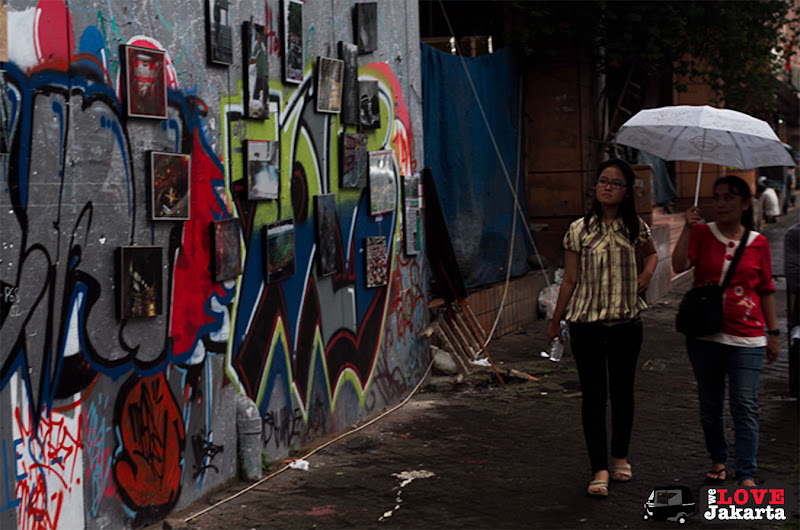
Last weekend we went to see the Cikini Street Exhibition named Galeri Jalanan Bau Tanah.  Set up by a group of professional and amateur photographers, this exhibition aimed to show people across Indonesia who are looking after the environment using traditional methods, and the changes that are taking place.  Unfortunately it was raining when we got there so much of the exhibition had to be packed away, but in true Indonesian style, a little rain never stopped anything.

We were shown around by a young man who explained the event and then took us upstairs to show us a workshop that was going on at the train station, one of many that the group puts on to educate people for free.  At that time a photographer was explaining his trade as a group of enthusiasts engaged in his talk.

It was a reminder to me that people are doing great things in Indonesia – aiming for change, celebrating diversity, offering to educate people for free, to share knowledge and in this spirit, rain or no rain, the exhibition was a success.

Where’s My Mbak?

One of the first cultural confusions I encountered in Jakarta was these strangely dressed young girls wearing matching pink or green, or white with blue trimmings uniforms – sometimes hanging out together but more often alone.  Sometimes they were clutching a child, or carrying bags, other times they were to be found in kitchens or loungerooms or on the street with a straw broom endlessly sweeping.

In my first job here in an Early Childhood school, I met these women en masse carrying Ben 10 and Barbie backpacks, helping children with their shoes and sometimes even being yelled at by toddlers.  They would sit out the front of the school for hours eating gorengan and having their daily curhat until class time was over.  After school finished there was a buzz of children running to these women who were armed with a spoon and a lunchbox full of rice and they proceeded to chase after the kids shoveling as much rice as they could into their mouths.   When I went to the malls, this phenomenon continued.  Here were the uniformed young girls clutching the baby, and there was the mum wearing 5 inch heels and clutching an enormous handbag.  Let’s call this phenomenon ‘pembantu-itus’ or ‘Mbak Time’ or ‘the Art of Sitting Around Comfortably While Another Sweeps’ or ‘Ways To Have A Baby Without Having To Change All Those Pesky Nappies’.

Where we come from, nannies are a luxury only afforded by the rich, here in Jakarta it seems that everyone has one.  If not a nanny, then some kind of pembantu to look after you.  It was a strange thing to become accustomed to as I moved into my school lodgings.  Every morning as I got ready there was a woman in my room who could speak no English, and I could speak no Indonesian so conversation was limited.  It didn’t take me long to learn “sudah makan?” as it was the most common question asked and if I shook my head some toast would appear.  Then she would walk around the room shifting things and wiping things with a cloth.  I couldn’t work out what on earth she was doing there, surely I could add my own hot water to my 3-in-1 coffee and put the bread in the toaster?  But it seems that this wasn’t an option here.

In the beginning I felt like a neocolonialist having a woman cleaning up around me as I attempted to do work or be comfortable in my room.  I had never felt so uncomfortable in my life.  And I could never find anything.  Everything was tidied up into neat piles and put in some unlikely place never to be found again.  This woman was employed 6 days a week by the school to clean up after me, and I was only living in a single room.  It seemed totally absurd.   I would wander the streets after my working hours waiting until her working hours had finished so I could relax in my room.  I would speak to other bules who had been here for a while and they said it was a good thing, it gave many people jobs so they could send money back to their families.  But something didn’t feel right.

As I went into Indonesian friends’ houses, after my eyes started to adjust and I stopped trying to shake the hand of the ‘mbak’ when I was being introduced to everyone else, I saw that Indonesians were very comfortable asking this woman to make them a cup of tea or to pop down to the warung to pick up some nasi pecel.  And that chasing after a child (or someone seemingly big enough to feed themselves) with a giant spoon of rice wasn’t just done at preschools.

When we were growing up, we couldn’t ask even our mum to make us some tea, and if we did ask for anything it was met with a resounding “you have two arms and two legs, go and make it yourself”, so we would.  If you wanted someone to do something for you that made them get up from the couch you had to flip a coin or agree to do a different job later.  We had never heard of a land where you had a woman living in the tiny room of your house who would do stuff for you.  This only happened in fairy tales and she usually ended up married to the prince. Inconceivable.

Even after 3 years, I am not at all comfortable with the whole business.  There is an agreement in my house that I do not deal with the pembantu and that my boyfriend, who is Indonesian, takes care of her.  Experience has shown us that when I deal with her, the guilt and neocolonialist feeling grip me, I feel awful that I am sitting down while they are sweeping, I send them home, I give them money at random moments until after a while they are constantly asking for loans and spend most of the time sleeping in the upstairs room and telling me how their brother or sister can’t afford an education and could I pay for their school fees?  This feeling that I have too much while they have too little envelopes me and I don’t know what to do with that guilt.  So I try and push it to the back of my consciousness and enjoy this new feeling of ironed clothes.

There is a strange hierarchy in Indonesia, of which I am yet to understand, where it is okay to employ people for a tiny wage to do all the things you don’t want to do; drive your car, iron your clothes, clean your pool, feed your children.  I can’t work out if it is an effect of Javanese culture or 300 years of colonial rule or a combination of both.  I saw the movie “The Help” recently and had a little panicked feeling that 1950s America, looked a lot like 21st century Jakarta – just replace African American women with the country girls of Java and Sumatra.  Perhaps I am being over-dramatic. Perhaps it will just take some more time to adjust to this culture.

Maybe I could buy a little bell to summon my mbak, maybe I should look forward to having children and have someone else to wake up in the middle of the night to soothe my child.  Maybe I will even let her come to the mall with me and hold my child while I enjoy a delicious meal that costs more than what I pay her for a month.

I have a fear that, if I return to Australia, I will have forgotten how to turn on the vacuum cleaner, or will have forgotten how to have an argument with my boyfriend about the unfairness of me always having to clean just because I am a woman.  I will have forgotten how to boil the kettle or drive a car.  I will have forgotten my belief that all people have a right to equality.  Or I will ask mum to make me a cup of tea and she won’t leave me her porcelain figurines in her will.  So many worries.  So futile. Hmm, now I am thirsty and my legs don’t seem to work…”Mbak..lagi di mana?”.

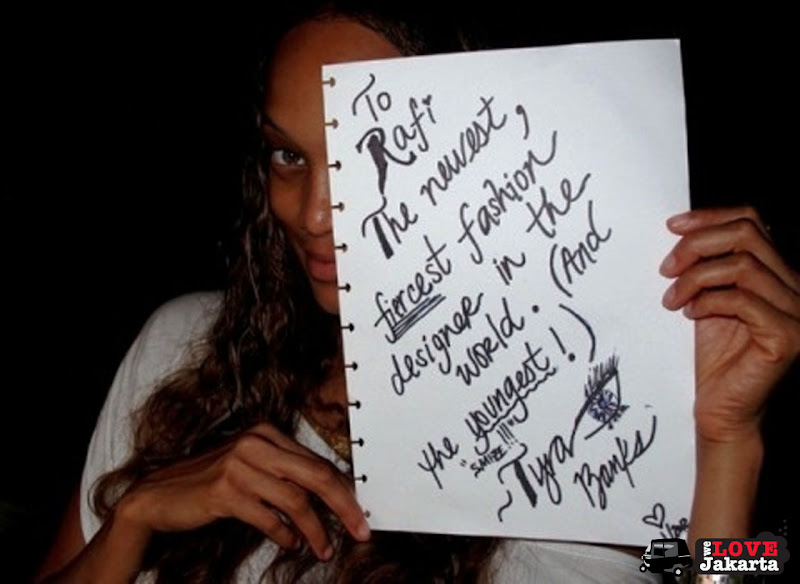
Thank you Tyra Banks!

Yah! Following on from our story on Indonesia’s youngest fashion designer, Rafi Abdurrahman Ridwan, which was also printed in Jakarta Expat Magazine, a response was received by Tyra Banks!

Wishing you success always Rafi and a huge thank you to Tyra Banks for making one of his dreams come true xx

Thank you Tyra!

This Traffic is Making Me Gila

Traffic near Jalan Warung, Jati Barat, Pejaten

View from the overpass of macet on Jl. Sudirman

Riding along Jalan Mampang Prapatan

The only way to stay sane and hopefully move in traffic is on a crazy ojek!

It's motorbikes vs. SUV's on the roads..

It’s not news that Jakarta has traffic problems. It is the first conversation on everyone’s lips when they first meet you, “so what do you think of Jakarta? Macet banget, yeah?”. And I wholeheartedly agree. This traffic confines me to the house as the malas feeling grips me when I consider venturing out to explore this great city. Today is such a day so allow me to move away from “welovejakarta” into a resounding what-the-hell- is-going-on- in-this-place vent for a moment.

When I first came to Jakarta I loved seeing the madness of the traffic – I thought it was fantastic that a bus could stop anywhere as I remembered all those times in Melbourne when I ran for the bus but it didn’t stop for me because I wasn’t at the bus stop. I marveled at how people in Jakarta don’t experience the same road rage in the congestion as Australians do in traffic that almost always is at least moving. I thought it was hilarious to see a horse and cart (andong) trying to make its way around the buses, or a kaki lima owner pushing his shop on wheels up the busy highways. I enjoyed bouncing along footpaths on an ojek and seeing the jockeys standing on the side of the road waiting for someone who wants to use the freeway to pick them up for 10,000 rphs so the driver could bypass the “3 drivers or more” rule on the tollroads. I even liked the parking guys who could help you make a right hand turn no matter how full the roads were. I remembered back in Australia having to wait 10 minutes to be able to turn right at some intersections. Now, I am not so sure.

Jakarta’s traffic is like a giant game of tetris – if there is any space, it will be filled with some form of transport whether they should be in that lane or not. Metro Minis, angkots and Kopajas fight for passengers flying dangerously along the roads where they can, and stopping wherever and whenever they want to pick up passengers, not bothering to worry about the drivers around them, and of course blasting everyone with a gust of black smoke as they take off again. Come to think of it, they don’t always actually stop to spew the passengers off the bus into the incoming traffic ,they just slow down enough so they can jump off. Although there is no road rage, there is certainly a degree of ‘survival of the fittest’ on the road.

If I ride my little push bike to work and experience the constant near-death experiences as motorbikes and cars overtake me only to turn left immediately in front of me so I have to slam on the brakes, or people pull out of the street and turn onto the road without bothering to look if someone is on the road, I just think, oh my god, maybe there is no road rage because people don’t see other road users as actual human beings who will die if you hit them. Luckily the roads are so congested in some ways because at least people are generally going at slow speeds.

In some ways I respect the Indonesians on the road trying to get to their destination however they can. They ignore policemen who attempt to futilely control traffic. They ignore red lights. That is if the lights are working. They ignore basic driving on the left hand side rules. And why the hell should they follow the rules when the government doesn’t? The government will allow as many cars as they can on the roads without building any new roads for them to drive on.

They have accepted loans over the years to build public transport but the public transport never came, but those guys are surely the ones buying Rolls Royce’s at Pacific Place. Or maybe I am too cynical. And if you get pulled up by the police you can give them a little tip and be sent on your way. The only seemingly sanctioned form of public transport is the busway which took up a whole lane of traffic to create, and is, more often than not, full of motorbikes who shouldn’t be in there.

As long as corruption rules in this city, there is no way to fix the problem. There is no time for creating infrastructure and certainly no money put aside to provide for the future or to look after the average Jakartan.  If the government want to get through the macet they just get a police escort and shut down the roads, leaving more traffic for everyone else, but at least they can get to their appointment, even if it’s their wife’s not-to-be-missed hair dressing appointment.

I am filled with dread as I see the new apartments and malls being built around the city on small roads that are already filled with traffic. I just think “what the hell?”. And as I sit in traffic for an hour just to get up the road to make a u-turn to go the way I actually want to go, I wonder how much longer this can last. I know that total gridlock is expected in a few more years so I guess the ever-creative people of Jakarta will work out ways to survive it.

And if there is something I can’t complain about, it is the ability of people in Jakarta to find a way to make it work and to survive and create new ingenious ways of buckling the rules a bit to suit them and their family. In Australia, the government creates a new rule and then shames people through the media who dare to break these rules until it has entered the public consciousness enough for citizens to police themselves and shame each other. And there are hefty fines to pay if the rules are broken. If you don’t buy a train ticket, they can now justify fining you $150 by saying that by not paying your fare you are making others suffer. If you don’t wear a seatbelt it can cost you $500 and they justify it by saying you are putting other people’s lives at risk. No helmet? $200. Go through a red light? $600. Break the rules too many times? Lose your licence for 6 months. Drive without a licence? You could end up in jail. And the public would support your jail sentence as you hang your head in shame; you knew the rules and you disobeyed – shame on you.

In Indonesia, the government makes a rule and the people find a way to ignore it. I think some kind of evolution has taken place in people who were born in Jakarta. They are born with an endless supply of patience or acceptance of their present circumstances. Kids don’t complain here about getting stuck in traffic like we do. People don’t complain about being squashed in overcrowded buses like sardines. They barely move a muscle when they are behind a bajaj blowing black fumes into their faces. In Australia we would be screaming “oi, get a service mate”.

People will say in a calm way “it takes me 2 hours to get to work each day” without complaint or anger or the belief that it shouldn’t be that way and that someone should do something about it. That hope for someone to fix the problem doesn’t seem to exist. People have to fix their own problems here or just laugh about it. Maybe I have to learn the skill to laugh more about it. But laughing about sitting in traffic isn’t a skill I have. I only the shakie feeling of wasting precious time. And time is money, as we are taught.

So from a long complaint about macet I guess this post has come around to an admiration for Indonesian people who don’t bother to complain. When I look at their faces squashed on an overcrowded bus as a musician gets on to busk for money, I don’t see anyone rolling their eyes or looking impatient. I just think “what on earth are you thinking looking so calm as you are squashed under a stranger’s armpit”. Maybe they are praying. Maybe they are thinking of their children. Maybe they are dreaming of food.

I hope someone in Indonesia can teach me the art of endless patience, but I think it may be genetic. Oh well, I think I will stay home today.

Kids Gone Wild at Kidzania, Pacific Place

Welcome to the Brave New World

So do you want to work for Trans7?

Or be a scientist?

Would you trust these kids to put out a fire?

Anyone for a Bachelor of Hamburgerology?

And after a hard day at work, it's time to let loose in the disco!

If you didn’t have children you may think that a trip to Pacific Place is just for the ultimate bed cinema or a fancy cocktail at Potato Head or a browse through Aksara books. Kids who have experienced Kidzania think differently. They know that on level 6 of the mall there is a world full of noise and adventure where adults play a minor role and the kids can run free exploring a wide range of jobs on offer.

Kids are given Kidzania dollars and ATM cards to take out more play money and sample, not just the average jobs we are taught about like police men, firemen and doctors but also fashion models, tailors, radio DJs, dentists, scientists, accountants, racing car drivers and marketing executives. Kids line up to try out working in a chocolate factory or tea factory and get to take their tasty treats home with them.

It really has to be seen to be believed as you wander through this giant playground filled with thousands of children and marching bands walking through and kids dressed as policemen chasing robbers while others are flipping burgers.

It is the only place in Indonesia where people stop at pedestrian crossings to let the miniature blue bird taxis get past, where drivers actually stop at red lights and fire engines actually make it to the fire before a house burns down. It is a world where workmen and window cleaners have the best jobs and even get to wear safety gear, where children pump petrol at the mini petrol station and scan groceries at Indomart.

It is a place that could never work in a country like Australia where you have to pay people a decent wage. Here the hundreds of Indonesian staff members patiently explain over and over again the different activities and try and rein in the chaos a little as the over-excited groups of children try and dip their hands in the chocolate or cry because they have no more money in the ATM. They stand in the pumping disco for hours with music blasting teaching kids how to dance.

As the noise and over-excitement got to me and I felt the tiredness creeping in, I thought of the world outside the mall where workmen build roads in their sandals, or climb up scaffolding with no safety measures in place and risk their lives every day, where little kids do pump petrol and people work all year in horrible sweatshops, and the organized chaos of Kidzania seemed to be a mockery of the real chaos outside. The companies who bring their booths to Kidzania get free advertising from plasting their label everywhere, and they all get to pretend to be fair employers where those who work at petrol stations get the same wage as those who work in marketing.

But as the kids ran past me with pure joy on their faces, I realized how much it sucks being an adult where you can’t be lost in the fantasy world anymore, even an entire miniature word of happiness for children. Maybe I was just jealous because I wasn’t allowed to try out any of the games.

Back in Jakarta for 2012

Well it’s been a while since we have posted on the blog as we have both been back in Melbourne, bringing with us, my sweety sayang for his first trip to Australia where he marveled at the empty streets, the wide open spaces, ticket machines, big houses and the lack of availability of Indonesian cigarettes and places to smoke and the fact that EVERYTHING is so expensive in Australia and yet, people still seem to have money to buy houses and cars and Ipads. It’s a mystery.

But now we are back in the madness of Jakarta talking macet again, getting blasted with the toxic fumes of bajajs and the dreaded kopaja buses, cruising around on ojeks and at last my sayang can get back to the Indonesian diet of rice 3 times a day (the rice salad just wasn’t cutting it for him in Australia). We are back in the land where it is possible to smoke in any location (except around bules), it’s possible to have everything delivered and of course it’s possible to walk for 2 minutes and have an abundance of food at your disposal. And it’s cheap. And delicious.

As the years pass living in this city, what was strange before becomes more normal. It’s more normal to see rats running around your street and around the warung where you are enjoying a meal. It’s normal to call out to a waiter even if he is in the middle of something or to call out your order for soto betawi as soon as you enter (“just meat please. No innards”) and it’s more normal that they will remember your order as soon as you enter even if you haven’t been there in months. It’s more normal to have people calling out “hey bule” as you walk past. It’s more normal for people to start laughing as you walk away (as you know that one of them probably just tried to say something in English). And it is great to be back. It’s a beautiful time of year right now with constant rain and cooler evenings.

As I ride to work through the jalan tikus (little streets) that run through the small kampungs and everyone calls out hello and smiles at me, or past the old men who always play tennis in the mornings and they ask me to join them, I feel a little ball of contentment in the pit of my stomach.

Other times I long for the order that fills Australian life and my expectations – when people push me to get in front of me, when motorbikes are on the wrong side of the road and I forget to look 5 ways before crossing the road or the metro minis race to pick up passengers nearly toppling the pedestrians on the side of the road, or I narrowly miss falling into a pot hole, every day a new near death experience – but I guess these are the times, strangely, when we feel the most alive and the numbness that threatens the western consciousness is pushed aside.

Anyway, it’s great to be back in the madness of Jakarta. Welcome to a new year. The Year of the Dragon. Bring on the happiness and success of this auspicious year.